
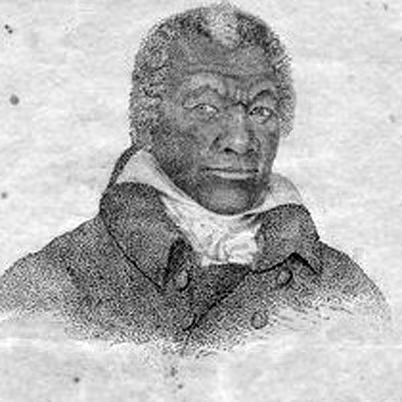
The Man Who Helped Win a War Without Firing a Famous Shot
When people talk about the American Revolution, they usually talk about generals. Strategies. Surrenders.
They rarely talk about the man who walked calmly through British camps while carrying the fate of a young nation in his memory.
James Armistead did not command troops. He did not sign declarations. There is no towering monument built in his honor in Washington, D.C.
And yet, his decisions shaped the outcome at Yorktown—the battle that effectively ended the Revolutionary War.
For Black Americans, his story lands differently. It is not just about espionage. It is about contradiction. About fighting for freedom while legally owned by another man. About believing in an idea that did not yet believe in you.
Born Into Bondage: Hearing Liberty From the Outside
James Armistead was born around 1748 in Virginia, into slavery. That fact alone defined his legal status, his mobility, and his future—at least on paper. Virginia law treated enslaved people as property. They could not testify in court against white citizens. They could not move freely. Their labor enriched others.
And yet, they heard everything.
Plantations were not sealed chambers. Political arguments about “taxation without representation” and “natural rights” were discussed within earshot of enslaved workers. Imagine listening to men debate freedom while knowing the debate did not include you.
That paradox matters.
Enslaved communities developed sharp survival instincts. They observed. They remembered. They learned how power operated. You had to. A misread expression could cost you dearly. A misjudged tone could change your day or your life.
Those skills would later serve Armistead in ways no one could have predicted.
A War That Opened a Narrow Door
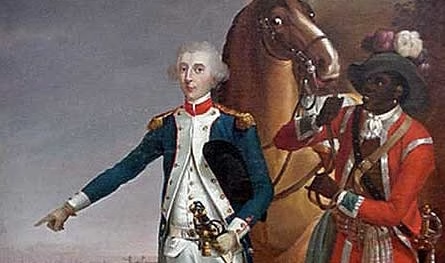
When the Revolutionary War began in 1775, it disrupted the social order. Not completely. Not cleanly. But enough to create cracks.
Both the British and the Patriots made offers to enslaved Africans: serve us, and you may gain your freedom. These were strategic decisions, not moral awakenings. Still, they created a new calculus.
For someone in bondage, war was terrifying. It was also an opening.
In 1781, James Armistead received permission from his enslaver to join the Patriot forces under the Marquis de Lafayette. This was not a safe move. If captured while spying, he could have been executed without hesitation. If the war failed, his situation might have worsened.
But he stepped forward anyway.
It is easy to romanticize that decision. It was likely far more complicated—part hope, part strategy, part necessity.
Inside Enemy Lines: Turning Invisibility Into Power
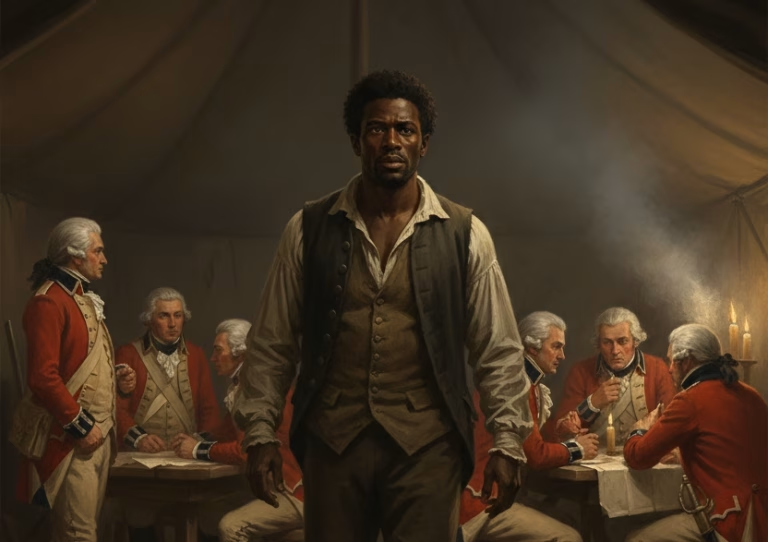
Armistead did not serve as a typical soldier. Instead, he posed as a runaway enslaved man seeking protection from the British. The cover was believable. British commanders were actively encouraging enslaved people to defect from Patriot owners.
Because British officers underestimated him, they trusted him.
He moved through camps with relative freedom. He listened to officers discuss troop movements. He observed supply routes and defensive positions. He gained access to Benedict Arnold’s camp after Arnold defected to the British.
And then he carried that information back to Lafayette.
If you think about it in modern terms, he functioned like a high-level intelligence analyst embedded inside a competitor’s headquarters, except the penalty for discovery was death.
He also did something even more daring. He fed misinformation to British leaders, including General Charles Cornwallis. He suggested that American forces were weaker and less coordinated than they truly were. He reinforced assumptions the British already wanted to believe.
That subtle distortion made a difference.
Yorktown: When Information Became a Weapon
By the fall of 1781, Cornwallis had positioned his forces at Yorktown, Virginia. He expected support from the British navy. He believed he had strategic breathing room.
He was wrong.
American and French forces, working together, encircled Yorktown by land while the French navy blocked escape by sea. The coordination required confidence—confidence built on intelligence.
Armistead’s reports gave American commanders insight into British troop strength, defensive weaknesses, and expectations for reinforcements. That knowledge allowed Washington and his allies to plan carefully rather than guess.
On October 19, 1781, Cornwallis surrendered.
It is difficult to measure precisely how much any one person influenced that moment. Wars are complex. Many factors converge. But Lafayette himself later confirmed that Armistead’s intelligence was essential.
Information narrowed uncertainty. And uncertainty often decides battles.
Freedom Was Not Immediate
Here is the part that still stings.
After the war, James Armistead returned to slavery.
Despite his service, emancipation was not automatic. Laws in Virginia did not guarantee freedom for enslaved men who aided the Patriot cause. So he petitioned the Virginia legislature in 1783, requesting legal recognition of his contributions.
It took years.
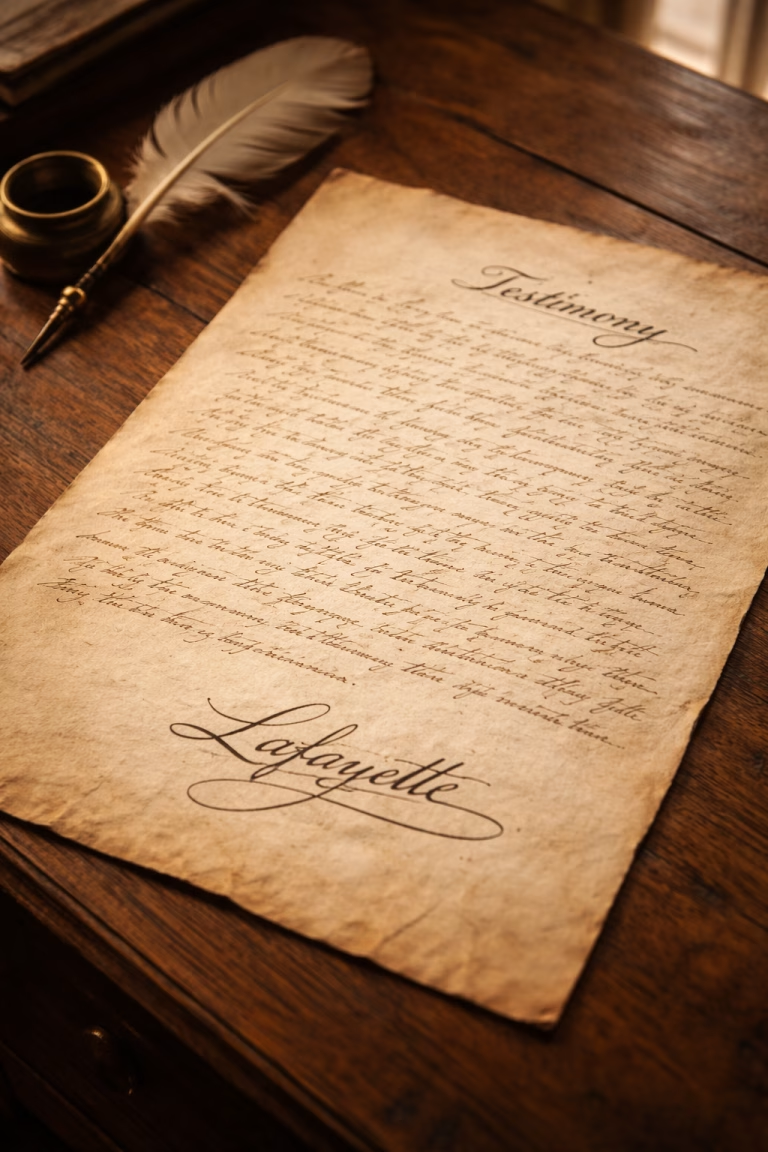
The Marquis de Lafayette submitted written testimony supporting him, detailing the risks he took and the value of his intelligence. That endorsement carried weight. In 1787, the legislature finally granted his freedom.
He chose a new name: James Armistead Lafayette.
That addition was not cosmetic. It reflected gratitude, partnership, and perhaps a quiet assertion of dignity. He later purchased land and farmed as a free man. He even received a state pension for his wartime service: something many Black veterans never saw.
What His Story Means Now
James Armistead Lafayette complicates the narrative of American freedom. He fought for a nation that did not yet recognize him as fully human under its laws. He believed in principles that were inconsistently applied.
That tension echoes through Black American history.
From the Revolutionary War to the Civil War to modern military service, Black Americans have repeatedly contributed to national defense while pushing the nation to expand its definition of citizenship.
Armistead’s life also highlights a quieter form of power. Not the loud power of command, but the disciplined power of strategy. He turned underestimation into leverage. He turned invisibility into access. He turned information into impact.
His story is not simply about espionage. It is about agency under constraint. About navigating systems designed to limit you and still finding space to act.
History does not always celebrate those who work in the shadows. But sometimes, the shadows are where the decisive work happens.
James Armistead Lafayette understood that. And because he did, the course of American history shifted—quietly, but unmistakably.