History has a habit of choosing its favorites.
Not always the most capable. Not always the most prepared. Often just the most convenient. And when history does that, entire lives—entire contributions—can fade into the background, even when they were central to the moment itself.
Matthew Henson’s story lives in that uncomfortable space.
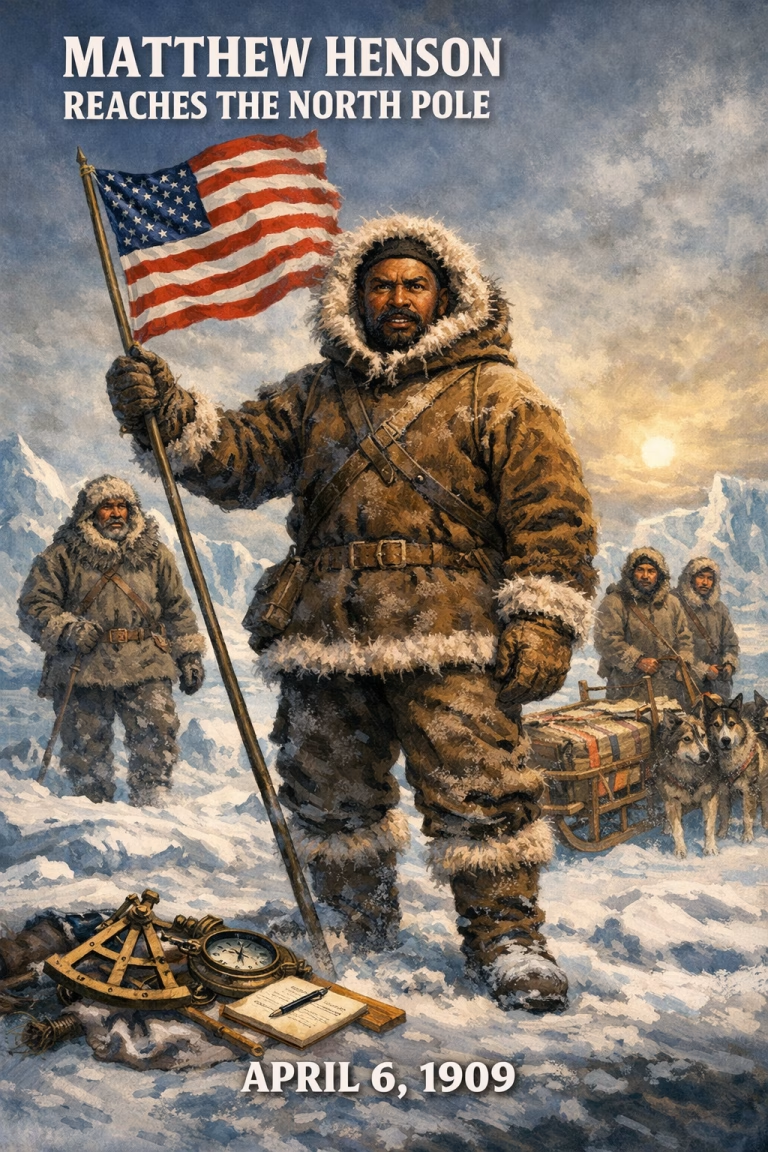
On April 6, 1909, at the northernmost point of the planet, a place so hostile it strips away pretense and ego alike, a Black American explorer stood on shifting ice and realized he had arrived first. Not first among assistants. Not first among “support.” First. Period.
And yet, for much of the twentieth century, you could read about the conquest of the North Pole and never see his name.
That absence tells us as much about America as the achievement itself.
A Childhood That Didn’t Promise Anything
Matthew Alexander Henson was born in 1866, just after the Civil War, into a country still arguing—sometimes violently—about what freedom was supposed to mean. His parents were sharecroppers in Maryland. Life was hard, predictable in its difficulty, and unforgiving in its limits.
Then it became harder.
Both of Henson’s parents died while he was still young. There was no safety net waiting beneath him. No extended pause where grief could settle before reality demanded something else. By twelve, he ran away to sea.
That detail is often told quickly, but it matters.
Life aboard a merchant ship was not romantic. It was rigid. Demanding. Cold in ways that had nothing to do with temperature. But it also offered something rare for a Black boy at that time: structured learning. Under Captain George Childs, Henson learned to read and write well. He studied navigation. He absorbed discipline through repetition, not punishment.
More importantly, he learned how the world worked beyond America’s racial boundaries.
He saw ports across continents. Watched how men behaved under pressure. Learned when to speak and when silence was smarter. Those lessons don’t show up on résumés, but they show up in survival.
Long before the Arctic entered his life, Henson had already learned how to endure.
Finding a Place Where One Wasn’t Meant to Exist
When Henson met Robert Edwin Peary in Washington, D.C., the meeting wasn’t historic. It was practical. Peary needed help. Henson needed work. What Peary found was someone unusually capable. Someone who didn’t need supervision and didn’t fall apart when things broke.
That mattered more than background. At least at first.
Exploration in the late nineteenth century was not an open field. It was controlled by institutions, sponsors, and social networks that rarely extended to Black Americans. A Black explorer was not just rare: it was inconvenient to the image being sold.
Still, the Arctic is an unforgiving equalizer.
Out there, ambition without competence gets people killed. Henson proved, repeatedly, that he could do what others could not. He repaired equipment under pressure. Managed logistics. Navigated in conditions where maps were more suggestion than truth.
Peary may have led the expeditions on paper. But Henson kept them moving in reality.
It was an unequal partnership. Everyone involved knew that. But necessity has a way of cutting through illusion.
Learning What Others Refused to Learn
One reason so many Arctic expeditions failed is simple: arrogance.
European explorers arrived believing their methods were superior, their technology sufficient. They dismissed Indigenous knowledge as outdated or irrelevant. The Arctic punished that thinking without hesitation.
Henson paid attention instead.
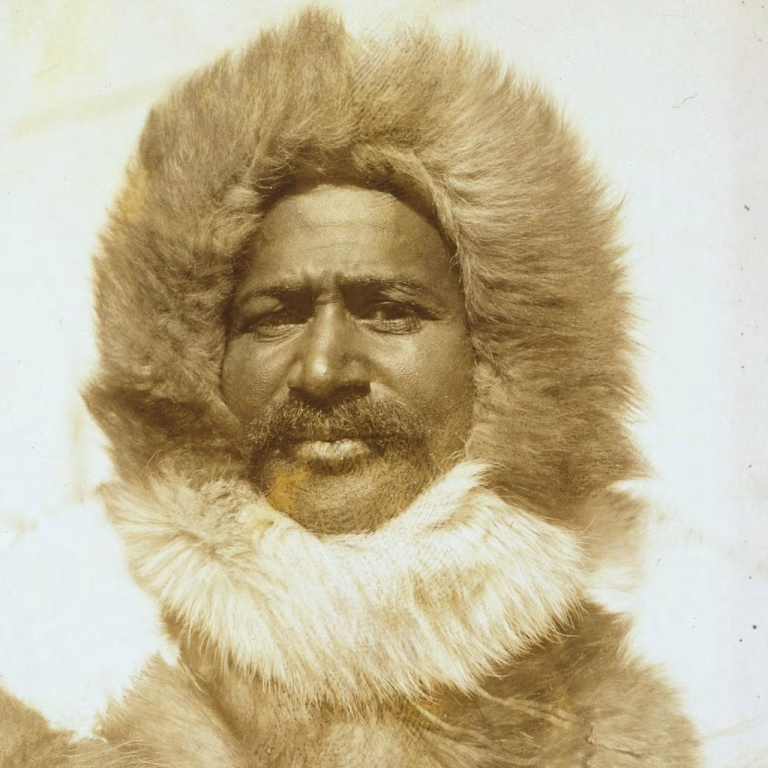
He watched how Inuit communities dressed, not for appearance, but for survival. How they layered animal skins to hold heat without trapping moisture. How they traveled efficiently across ice that shifted and cracked without warning. How they hunted with restraint, understanding that waste was dangerous.
He learned the language. Earned trust. That part matters more than it’s often given credit for.
Trust changes what people are willing to share.
Henson didn’t borrow Inuit techniques as a novelty. He adopted them because they worked. That willingness—to adjust, to listen, to discard ego—gave the expeditions a chance they otherwise wouldn’t have had.
In leadership training today, we call this adaptive intelligence. Back then, it was simply survival.
The Long Walk Toward April 6, 1909
By the time the final push toward the North Pole began, the expedition had been stripped down to its most capable members. Anyone who slowed progress was sent back. Supplies were reduced to the bare minimum. Every decision carried consequences.
The environment was relentless.
Temperatures plunged. Hunger lingered. Sleep came in brief, restless intervals. Ice floes shifted beneath their feet, opening dark water where solid ground had been moments before. Progress was slow and uncertain.
Peary struggled physically. Henson did not.
He led sled teams with an ease that came from years of experience. He understood the dogs, the terrain, the rhythm of Arctic travel. When calculations confirmed their arrival at the Pole, it was Henson who stood ahead of the group.
Later, he wrote, “I was the first man there.”
It wasn’t a boast. It was a record.
When Credit Went Elsewhere
What followed was painfully predictable.
Robert Peary returned to public acclaim. Lectures. Honors. A permanent place in history books. Matthew Henson returned to a country that barely acknowledged him. He struggled financially. Took government jobs far removed from the magnitude of what he had accomplished.
This wasn’t forgetfulness. It was exclusion.
The idea of a Black man standing first at the top of the world did not fit the story America wanted to tell about itself at the time. So the story was adjusted.
Henson documented his experience anyway. His 1912 book, A Negro Explorer at the North Pole, preserved his account. It didn’t immediately correct the narrative, but it kept the truth alive long enough for future generations to find it.
Sometimes history doesn’t change quickly. It just waits.
Recognition That Arrived Late—but Still Matters
Decades passed before acknowledgment came.
In 1944, Congress awarded Henson a medal for his Arctic service. Geographic institutions began revising their accounts. After his death, he was reinterred at Arlington National Cemetery, placed near Peary himself.
The symbolism was powerful. And bittersweet.
Recognition delayed is not the same as recognition denied but it leaves scars all the same. Still, correction matters. It reshapes memory. It opens space for honesty.
And honesty is long overdue.
Why Matthew Henson Still Matters
Matthew Henson changes how heroism looks.
He wasn’t loud. He didn’t control the narrative. He led through competence, preparation, and adaptability. His excellence wasn’t decorative, it was functional. Without him, the expedition likely fails. Full stop.
For Black Americans, his story expands the boundaries of Black history. It reminds us that Black brilliance has always existed in places where it was never expected to appear: ice fields, laboratories, navigation charts, survival science.
For anyone building something difficult—whether a business, a career, or a life—Henson’s lesson is quietly powerful: mastery matters, even when recognition doesn’t come right away.
Sometimes history catches up.
Sometimes it needs help.
Matthew Henson stood first at the top of the world.
And slowly, deliberately, truth is restoring him to his rightful place at the center of the story.